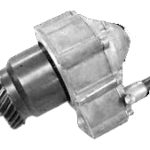
Dual Range Gear Splitter / Overdrive


NOTE: The Dual Range is COMPLETELY out of production. 

US Gear Corp has been sold, and the new owner completely scrapped the tooling and old parts. It's gone. I have not parts, Sorry.

They are completely out of production, no factory parts available at all. I am out of it. It's all junkyard and scrounging from individuals or shops who may still have stuff. Like as in old brownie boxes. Sorry. good hunting!


Dual Range Frequently Asked Questions

Dual Range Pricing

  1. Will it void my vehicle warranty?
  2. What is the warranty on the Dual Range?
  3. What is the ratio of the Dual Range?
  4. How does the Dual Range work?
  5. How does the Dual Range compare to the competition?
  6. What vehicles will it fit?
  7. Is installation difficult?
  8. What fuel mileage improvement should I expect?

Dual Range Gear Ratio Tables

Phone Toll Free
888-316-2940


The Dual Range is available for most domestic full-size pickup truck, sport utility, van, and motorhome applications. Call us with your application and we can work out the details of an application for you.

Functions Exactly Like a 2-Speed Axle

Gear Splitting: What is it and what is it good for:

Mostly, the main benefit of a gear splitter is when you are either towing a heavy trailer, or the vehicle is a motorhome or bus in mountainous country. (Semis want them, but they already have them) Have you ever been trying to climb a long grade, and your rig just won't pull the grade, say, in third, then you gotta drop all the way back to second and climb it at 30 mph or wind out the motor. What a gear splitter does is it gives you additional gears in between your current gears. You will have that gear right in between 2nd and 3rd that would be perfect for that hill. Or in between third and fourth if that is the case. 

Available in an Overdrive -OR- Underdrive Model

Available as either 0.8 to 1 (20%) overdrive or a 1.25 to 1 underdrive

While these units are two speed units, it is advantageous to be able to ad gear splitting capability on in the form of either an overdrive or underdrive. 

Some applications are already geared well for the highway, however would benefit from gear reduction when towing or around town These applications would buy the Underdrive model. Available gears would be, for example, with an auto-overdrive trans: 1st-under, 1st, 2nd-under, 2nd, 3rd-under, 3rd, 4th-under (Partial O/D), 4th (full O/D). 

Other applications are geared well around town, but would benefit from increased overdrive capability at times. For Example, a powerful Diesel pickup might be at the top of its optimal RPM band at 70MPH, but certainly has the power to cruise at 85. It can do so efficiently and economically with an additional overdrive. In this case, an example of available gears would be (we'll use a 4 speed manual this time for our example) 1st, 1st-over, 2nd, 2nd-over, 3rd, 3rd-over, 4th, 4th-over. They can be used with 5 speed manuals and automatics as well, if additional overdrive would be desirable.

So which one is right for you?

Works in 4WD or 2WD

In some applications, it can be made to fit between the transmission and transfer case. Other 4WD vehicle applications are designed to bolt on BEHIND the Tcase, and will only work with the Tcase shifter to 2WD. This is the only product of its type that is designed to operate in 2 or 4WD


The overdrive unit gives you twice as many higher gear ratios than you originally had for more pulling performance, while the underdrive gives you twice as many lower gears for that extra power you need to get your weight moving easier with less throttle. Whichever unit you choose, you will improve economy, and decrease wear and tear on the engine.  Let's take a look at the different issues specific to motorhomes, trucks and vans.

Specific Truck and Van Issues
Trucks and vans that pull trailers, whether gas or diesel, automatic or stick, are distinctly different from motorhomes, because their loads can be dropped. This means that sometimes you'll be heavy while other times you'll be light. And because your engine produces its best power in a narrow rpm range, you will need the flexibility of numerous gear ratios to keep it running in the "sweet spot". If you own a newer model truck with an automatic transmission, chances are it came standard with an overdrive. But if you are towing really heavy loads, the OE overdrive may be too high even with the tremendous horsepower and torque produced by the engine. Even the original equipment manufacturers tell their customers NOT to pull heavy loads with it. Under this set of circumstances, you will need to add the Dual range to either replace, or lower the factory overdrive ratio to give you the power and economy you are looking for.

By selecting the proper Dual Range unit to complement your existing gear ratios, you can finally enjoy both low speed power and high speed economy. Our tech department can help you decide what is right for your set of circumstances.

Specific Motorhome Issues
Gasoline powered motorhomes with automatic transmissions are extremely heavy and continuously get heavier as amenities such as slide out rooms, washers, dryers and even the family sedan are added. They often come equipped with an overdrive providing the needed high gear ratio, but don't have the intermediate gear ratios for climbing the hills quicker and with less throttle; not to mention engine retarding for coming down the hill.  By adding this low range unit, the factory transmission becomes a real pleasure to use. Not only do you gain the pulling power so useful for towing, you're actually able to use that power in the factory overdrive mode.

How To Use The Dual Range
Nothing could be easier! An electronic control module mounts directly to the gear shift lever and permits precise control of the Dual Range Auxiliary Transmission. While the unit is electronically controlled, you will hear it shift mechanically as do big over-the-road commercial trucks. And it's this simple; keep the unit in the low range position when you are driving in mountainous regions or when heavily loaded, and shift to high when you're cruising on the interstates. Or, you can shift the Dual Range as you're shifting the primary transmission to split your existing ratios.

And the Dual Range Is a Real Work Horse
From the very beginning, the Dual Range was designed for towing extremely heavy loads. With a GVCW rating of 35,000 lbs and a torque capacity of 2000 ft lbs, the Dual Range has the strongest guts in the industry. It was specifically designed to use in either 2-wheel or 4-wheel drive, forward or reverse, both uphill or downhill compression braking, and at any speed. There simply is no limit to how and when to use the Dual Range. Again, no other auxiliary transmission manufacturer can make that claim.

Lubrication

The Dual range uses 32 oz or 80-90wt gear oil.

Applications Available
Pick-ups, vans, cab-chassis, class C or the very popular class A motorhomes, two-wheel or 4-wheel drive, We've Got Them All! We are adding popular new applications as soon as they become part of the towing world, so stay tuned!

Call our technical support department; tell them what you have and what or where you feel you need improvement. Chances are, they already have a solution.


Use with an Automatic Transmission

Advantage: will allow gear splitting (follow link above to see what this is and in what cases this is valuable)

Drawback: No Torque Converter lock-up: It is possible in many cases to add an overdrive behind an older 3 speed automatic, but since these do not have a lockup torque converter, there are compromises: When you go into OD the engine is asked to produce more torque at a lower RPM. This is fine, except then the torque converter then needs to work harder, and ends up using energy (fuel) and making excess heat. Unless your axle ratios are sufficiently high to still keep the torque converter in its more efficient RPM band (typically over 2500 RPM with gas motors), it will end up a compromise. Better to swap to a later model OD auto trans with lockup, or perhaps a manual 5 speed, or a 4 speed plus a splitter/OD or even a 5 speed plus a splitter.

Also Consider Overdrive-Auto Trans Conversion


Dual Range Frequently Asked Questions

  1. If I install the Dual Range, will it void my vehicle warranty?
  2. What is the warranty on the U.S. Gear Dual Range?
  3. What is the ratio of the Dual Range?
  4. How does the Dual Range work?
  5. How does the Dual Range compare to the competition?
  6. What vehicles will it fit?
  7. Is installation difficult?
  8. What fuel mileage improvement should I expect?

If I install the Dual Range, will it void my vehicle warranty?
No, the addition of the Dual Range doesn’t void your vehicle warranty. Automotive manufacturers such as Dodge, General Motors, Ford, Freightliner, and Spartan have publicized the fact that the addition of aftermarket products does not void their warranties. There has been a lot of confusion about this issue, but federal law actually prohibits manufacturers from voiding warranties based on the addition of aftermarket parts unless they can prove that the aftermarket item caused a failure in the vehicle.

What is the warranty on the U.S. Gear Dual Range?
U.S. Gear warrants the product from defect for one full year, with unlimited mileage, from the date of purchase. The warranty covers 100% of parts, 100% of labor, and all freight charges. A copy of the written warranty is included with each product.

What is the ratio of the Dual Range?
The Dual Range is available in two different models: Direct and 20% Overdrive or Direct and 20% Underdrive. The 20% overdrive ratio is .80 and the 20% underdrive ratio is 1.25.

How does the Dual Range work?
The Dual Range works exactly like an electric 2-speed axle commonly found in commercial trucks. The Dual Range bolts directly to the back of your factory transmission giving you the equivalent of two axle ratios or twice the transmission ratios (gear splitting). At the flip of a switch, you can select a high speed ratio for highway cruising or solo driving, or you can select a low range for highway towing, city driving, or mountain terrain. Shifting back and forth from high range to low range can be done at any speed (shift-on-the-fly).

How does the Dual Range compare to the competition?
 It has the heaviest GVCW rating (35,000#) and is the only auxiliary transmission available as either overdrive or underdrive. The Dual Range is also priced $500-$800 less than the competitors. The Dual Range is the only unit that has no limitations on how it is used. It can be used in forward or reverse, 2 or 4 wheel drive, uphill and downhill. No other auxiliary transmission manufacturer can say that.

What vehicles will it fit?
The Dual range will fit all Dodge, GM, and Ford full-size pick-ups, vans, Suburbans, class C and class A motorhomes with automatic or manual transmissions, 2 or 4 wheel drive.

Is installation difficult?
Installation of the Dual Range always requires shortening and balancing of the drive shaft(s). In 4WD systems, the Dual Range mounts between the transmission and the transfer case, allowing operation in 2WD & 4WD. In most applications, driveshafts are the only modification required; however’ on occasion modifications may be necessary to the exhaust system, floor pan, and in some 4WD applications, modification to the fuel tank (if moving the Tcase back 12" will cause interferance). The balance of the installation is a simple bolt-on and wiring the driver control that is supplied in each kit. High Impact provides free telephone tech support to customers before, during and after product installation

How much fuel mileage improvement should I expect?

depends on the torque curve of your engine, and how your axle gears are matched up. If you are pulling a heavy weight in hills, you will operate more efficiently when using the Dual Range as a gear splitter. Generally speaking, if you are spinning substantially more RPM at freeway speeds than needed - in other words if the engine would easily pull the truck efficiently at a 205 lower rpm - an overdrive will help. If so, you could experience substantial savings, sometimes as much as 20% If you Simply drop the RPM below the efficient part of the torque curve - in other words lug the engine - an overdrive will take you to the lower part of the torque curve or below it. This will not help fuel mileage.


Pricing


Hit Counter